University of North Dakota
    • Current Students
    • Faculty & Staff
    • Alumni & Friends
    • Email
    • Blackboard
    • Campus Connection
    • Employee Self-Service
    • Hawk Central
    • Degree Map
    • Zoom
  • Directory
  • Scope of this search:
College of Nursing & Professional Disciplines
  • About
  • Admissions & Academics
  • Research & Grants
  • RAIN
  • CLINICAL RESOURCE & SIM CENTER
University of North Dakota
  • About
  • Admissions & Academics
  • Research & Grants
  • RAIN
  • CLINICAL RESOURCE & SIM CENTER
  • Request Info
  • Visit
  • Apply
Scope of this search:
  • Request Info
  • Visit
  • Apply
Scope of this search:
College of Nursing & Professional Disciplines
  • Home
  • CNPD Research
  • Gero Starr
  • Gero-STARR Mentoring Model
Skip Section Navigation
  • Gero Starr
  • About Show/hide children
    • Framework
    • Mentor Model
  • Apply to Program
  • Our Team

Gero-STARR Mentoring Model

The Gero-STARR program is situated in the context of Caring, the overarching characteristic of the Gero-STARR program, which includes non-academic and academic support in a culture of belonging. Fostering a welcoming learning environment promotes a culture of belonging, which encourages positive well-being, academic engagement and persistence, reduced social isolation, improved mental health, and better academic performance (AACN, 2025).

The Gero-STARR Mentoring Model is illustrated as four nested circles, demonstrating a layered approach to student support. Each circle builds upon the one inside it, showing how different types of support work together to promote student success.
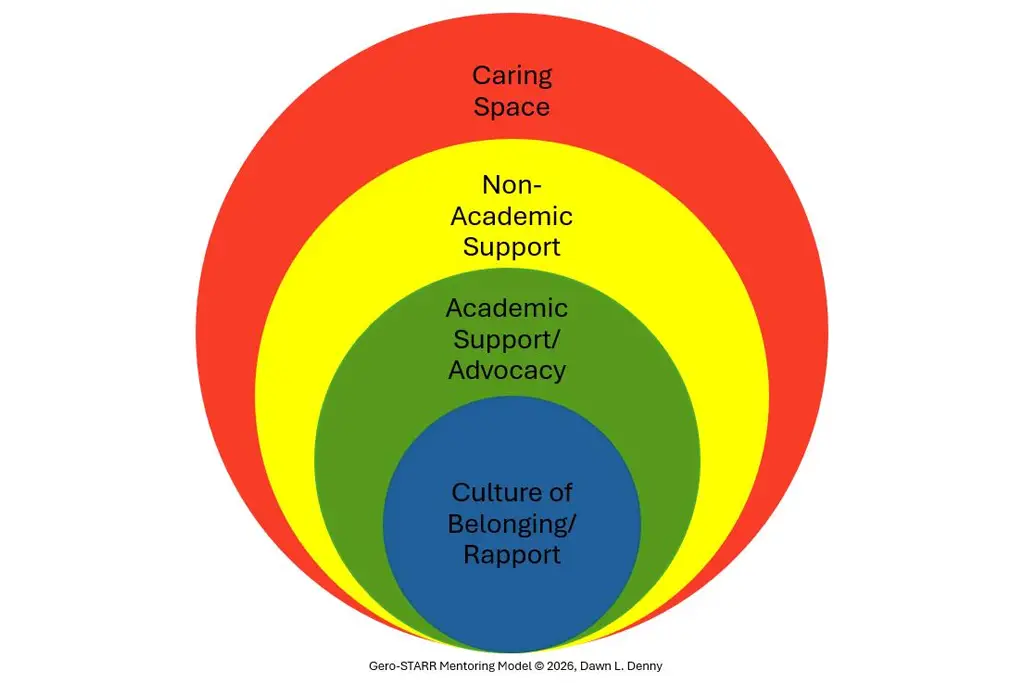
Diagram of the "Gero-STARR Mentoring Model" showing four nested circles that represent layers of student support. The outer red circle is labeled "Caring Space." Inside is a yellow circle labeled "Non-Academic Support," followed by a green circle labeled "Academic Support/Advocacy." At the center is a blue circle labeled "Culture of Belonging/Rapport," illustrating that a culture of belonging is the foundation of the Gero-STARR mentoring model, surrounded by academic support, non-academic support, and a caring environment.


Academic Support/Advocacy

Surrounding the center is a green circle labeled "Academic Support/Advocacy." This layer represents guidance that helps students succeed academically, including mentoring, advocacy, and assistance with coursework, clinical experiences, and professional development.

Non-Academic Support

The next layer is a yellow circle labeled "Non-Academic Support." This represents support beyond academics, such as connecting students with resources that promote well-being, resilience, and success throughout their educational journey.

Caring Space

The outermost red circle is labeled "Caring Space." This layer encompasses the entire model, illustrating that all mentoring and support occur within a welcoming, inclusive, and caring environment.

Together, the four layers show that the Gero-STARR Mentoring Model is built on a foundation of belonging and rapport, strengthened by academic advocacy and non-academic support, all within a culture of caring that promotes student success.

Hunter Bradley
NPCBR Building Room 270
400 Oxford Street Stop 8237
Grand Forks, ND 58202-8237
P 701.777.4506
hunter.bradley@UND.edu

We use cookies on this site to enhance your user experience.

By clicking any link on this page you are giving your consent for us to set cookies, Privacy Information.

College of Nursing & Professional Disciplines

430 Oxford St Stop 9025
Grand Forks, ND 58202-9025

UND.cnpddeansoffice@UND.edu  |  701.777.4555

  • YouTube
  • Instagram
  • Facebook
  • LinkedIn
  • Employment
  • Contact Us
  • Make a Gift
University of North Dakota

© 2026 University of North Dakota - Grand Forks, ND - Member of ND University System

  • Accessibility & Website Feedback
  • Terms of Use & Privacy
  • Notice of Nondiscrimination
  • Student Disclosure Information
  • Title IX
©